Chapter 1: The High Fence
I just got back from meeting my landlord—the guy I’m basically paying to let me hide out from my parents for the winter. This place is unbelievable. If you want to disappear, Star Valley in January is the spot. It’s about as far from the “Happy Valley” bubble of Provo as you can get without leaving the zip code.
My dad is still blowing up my phone about the Mission papers. “The MTC is waiting, Luke,” “Your Bishop called again, Luke.” Honestly? I just needed to see if I could survive a week without a curated schedule or a Sunday suit. So, I found this place. The Heights.
The Arrival
The driveway was basically a vertical sheet of ice. My brand-new 4Runner—which my folks bought me as a “pre-mission gift”—was sliding sideways by the time I hit the cattle guard. I pulled up to this massive, rugged timber-frame house. It looked like something a billionaire prepper would build: beautiful but “stay the hell away” energy.
A guy was standing on the porch. He didn’t have a Patagonia vest or a friendly “Welcome to the neighborhood” vibe. He looked like he’d been carved out of a mountain.
“Mr. Heath?” I called out, trying to sound like I belonged there. “I’m Luke. The guy from the Airbnb? Well, the long-term lease?”
He just stared. No “How’s it going,” no handshake.
“The gate’s closed for a reason,” he said. His voice was like gravel in a blender.
“I noticed! Totally get it. Privacy is huge up here, right?” I was babbling. I do that when I’m nervous. “Anyway, I’m stoked to be here. Just looking for some… quiet. Reflection. You know?”
“Walk in if you’re coming,” he grunted, turning his back. “And watch the dog.”
The Interior
The inside was a trip. It wasn’t “Jackson Hole Chic”—no fake antlers or fuzzy blankets. It was all heavy steel, dark wood, and old-school ranch tools that looked like they could actually kill someone.
A kid about my age, maybe a little younger, was sitting by the fireplace. He was wearing a filthy Carhartt jacket and had grease under his fingernails. He looked at me like I was a literal alien.
“Hey, man. I’m Luke,” I said, giving a half-wave.
The kid—Hank, I found out later—just spat into a Gatorade bottle and went back to sharpening a knife. Super chill.
“Sit,” Heath commanded. He sat in a massive leather chair that looked older than the state of Wyoming.
I sat. A massive Blue Heeler started sniffing my boots, growling low in its throat. I tried to pet it—big mistake. The thing snapped at my hand, and I nearly fell out of my chair.
“Whoa! Easy there, buddy!” I yelped.
Heath didn’t even look up from the whiskey he was pouring. “He doesn’t like tourists. Especially ones who don’t know when to keep their hands to themselves.”
“My bad,” I muttered, my face heating up. “So, uh, the Linton place? The ‘Glass House’ down the road? That’s where I’ll be staying? Is it always this… snowy?”
Heath finally looked at me. His eyes were dark, like he was looking through me at something thirty years in the past.
“The Lintons haven’t owned that house in a long time,” he said. “I own the valley. The snow stays until June. If you can’t handle a little powder, you might as well head back to Orem tonight.”
The Vibe
I should have left right then. Every “gut feeling” I’ve ever been told to listen to was screaming red flag. But there’s something about this guy. He’s rich—you can tell by the land—but he lives like a hermit. He’s got this intense, dark energy that makes my Sunday School teachers look like cartoon characters.
I think I’m going to stay. Not because I like it, but because if I can survive Mr. Heath and a Star Valley winter, maybe I won’t be so scared of whatever the Bishop has to say to me.
As I walked back to my rig, I saw a name carved into the wood of the porch railing, half-weathered away.
CATHY.
I wondered if she was the one who taught the dog to hate strangers.
Chapter 2: The Whiteout
Yesterday was a total disaster. I mean, honestly, it was just fudgen’ ridiculous. I woke up feeling all motivated to start my “self-reliance” journey, but the sky over Star Valley looked like someone had shaken a giant bag of flour over the mountains. By noon, you couldn’t even see the fence line.
Naturally, I thought I’d head back up to The Heights to check on my lease paperwork. My mom always says, “Procrastination is the thief of testimony,” and I didn’t want Mr. Heath thinking I was some flaky kid from Orem. Plus, I figured a little “neighborly service” might soften that crusty exterior of his.
I was wrong. Like, super wrong.
The Return
By the time I reached the main house, the wind was howling so loud it sounded like a choir of angry angels. I had to put the 4Runner in 4-Low just to crawl up the drive. When I knocked, Joseph opened the door just a crack. The smell of woodsmoke and old-school prepper food—probably freeze-dried beef stroganoff—wafted out.
“It’s snowing,” he said. Profound, right?
“Yeah, no kidding, sir! Guten Rutsch!” I beamed at him. I think that one means “Good slide,” which felt appropriate given the ice. Joseph’s eyes narrowed until they were just slits of judgment. He probably thought I was speaking in tongues. He looked at my manicured eyebrows and my crisp Patagonia shell and just let out a wet, hacking cough.
“The master’s in the yard. Go ’round if ye must be a nuisance,” he grumbled, then slammed the door.
I found Heath out by the barn, looking like a literal statue of spite. I tried to help him with a gate, but the wind caught it and nearly pinned me against the fence.
“Are you trying to commit suicide, or are you just naturally this dense?” Heath barked over the storm.
“Just being a helper!” I shouted back. “I think the weather is getting a bit… hässlich! You know, spicy!”
He just glared at me. “It’s a blizzard, you idiot. Get inside before I have to dig your frozen corpse out of the spring.”
The Awkward Dinner
Inside wasn’t much better. We sat in that massive, dark dining room. It was Cat, Hank, Heath, and me. Zill was moving around in the background, looking like she wanted to whisper “Run while you can” in my ear.
I tried to break the ice. “So, Cat! That’s a really cool vintage book you’re reading. Is it for a class? Or just for… personal growth?”
She looked at me like I’d just asked to borrow her toothbrush. “It’s none of your business, Luke.”
“Right on! Boundaries. I respect that. Ich habe keine Ahnung!” I chuckled. (I’m pretty sure that means “I have no idea,” which usually gets a laugh back home).
Hank snorted into his stew. He looked at my hands—which, okay, are a little soft because I use high-quality moisturizer—and then at his own scarred, grease-stained knuckles.
“You’re a long way from the temple, aren’t you, city boy?” Hank muttered.
“I’m just finding my path, man! Exploring the Hinterm of the world!” I said. I saw Joseph in the doorway, and his face turned a deep shade of purple. He looked like he was about to give a three-hour fire-and-brimstone talk on the “evils of the unnatural.” He stomped off, muttering something about “the cities of the plain” and “wickedness in high places.”
The Trap
The sun—if it was even up there—dropped, and the wind went from “loud” to “jet engine.” I stood by the window, watching the whiteout.
“I should probably head down the hill,” I said, my voice shaking just a tiny bit.
“You’re not going anywhere,” Heath said, not even looking up from his drink. “The road is gone. You’d be off a cliff in five minutes.”
“Oh, fudge. Really? Well, I don’t want to be a burden. I can just sleep on the couch! Or, hey, I have a sleeping bag in the rig—”
“You’ll stay in the house,” Heath snapped. He looked at Zill. “Put him in the oak room. And stay out of the north wing.”
Zill’s face went pale. She looked at me, then at the floor. “The oak room, sir? But… nobody’s been in there since—”
“Now,” Heath growled.
Zill led me up a creaky staircase that smelled like mothballs and secrets. She leaned in close as she opened a heavy, dark wood door. “Don’t touch anything,” she whispered. “And if you hear anything… just pray. You’re good at that, right?”
She hurried away before I could ask what the heck she meant by that. I stepped into the room. It was freezing. There was an old built-in bed with sliding panels and a desk covered in dust.
I sat on the bed and pulled out my phone. Zero bars. Fudgen’ heck. I reached for a stack of old, leather-bound journals on the ledge. The name on the inside cover wasn’t Heath’s.
It was Cathy.
Chapter 3: The Ghost in the Glass
I couldn’t sleep. The oak room felt like a giant freezer, and honestly, the “vibes” were just straight-up rancid. My dad always talks about the “Spirit of Discernment,” and right then, my discernment was telling me that I was in a place where something really bad had happened.
To distract myself from the wind rattling the timber frames, I started digging through the stuff on the ledge. It was a bunch of old books and journals—real analog stuff. One of them was an old New Testament, the kind they used to give out in the 90s, but the margins were absolutely covered in frantic handwriting.
The Journals
It wasn’t scripture. It was a diary. The name Cathy was written everywhere in a loopy, aggressive scrawl. I started reading, and man, it was juicy. It was like a 90s teen drama but set in this exact house.
She wrote about someone named Heath—our Mr. Heath, I guess, but as a kid—and how her brother, Hindley, was basically a monster to him. There was one entry that really tripped me out: “Heath and I ran to the ridge today. We saw the lights of the Linton place. It looked like a different planet. I want to live in the light, but I am made of the dark.”
Deep, right? A bit “main character energy,” but it was better than staring at the shadows. I must have drifted off because I had this crazy dream that I was back at the MTC, but instead of a suit, I was wearing a flannel shirt and I was lost in a blizzard, looking for a girl I didn’t know.
The Window
I woke up to a sound. Scritch. Scritch. Scritch.
At first, I thought it was a tree branch. But then I remembered—there are no trees tall enough to reach this window. I sat up, my heart doing like 120 bpm. The room was pitch black except for the pale grey light of the snow outside.
Scritch. Scritch.
I crawled to the window. The latch was old and rusted. I figured it was just the wind vibrating the glass, so I reached out to tighten it. The window flew open—the cold hit me like a physical punch—and a hand reached in.
A real, literal hand. It was small, ice-cold, and it grabbed my sleeve.
I didn’t just scream; I made a sound I didn’t know a human male could make. I’m talking a high-pitched, “I-forgot-how-to-breathe” shriek.
A face appeared in the swirling snow. It was a girl. She looked about my age, maybe a little younger, with wild hair and eyes that looked like they’d seen the end of the world. She wasn’t wearing a coat—just a thin, vintage-looking denim jacket.
“Let me in,” she wailed. Her voice was thin, like the wind. “I’m come home. I’d lost my way on the ridge!”
“Who are you?!” I yelled, trying to pull my arm back. I was thinking, Is this a prank? Is this some weird Wyoming hazing ritual?
“Cathy,” she sobbed. Her fingers were like icicles digging into my wrist. “I’ve been a waif for twenty years!”
I panicked. I’m not proud of it, but I slammed the window shut. I even used a stack of the old books to wedge the latch. I backed away, tripping over my own boots. “Oh fudge! Oh fudgen’ heck! Hilfe! Die Hexe ist hier!” (I think that means “Help! The witch is here!”—though I might have accidentally called her a sandwich).
The Aftermath
The door burst open. It was Heath. He looked terrifying—he was wearing a white undershirt and pajama pants, holding a heavy flashlight. He looked like he was ready to kill someone.
“What are you doing in here?!” he roared.
“There was someone at the window!” I gasped, pointing a shaking finger. “A girl! She said her name was Cathy! She grabbed me, Mr. Heath! Sie hat mich berührt!“
Heath’s face went from “angry” to “totally shattered” in half a second. He didn’t even look at me. He pushed past me to the window, threw it open, and leaned out into the screaming blizzard.
“Cathy!” he yelled. It wasn’t a normal shout; it was like a wounded animal. “Cathy, come in! Oh, my heart’s darling! Hear me this time, Catherine, at last!”
I just stood there, frozen. I’ve seen some intense stuff at Stake Dances, but this was on a whole different level. Heath was sobbing—actually sobbing—into the wind.
I didn’t wait for him to turn around. I grabbed my shoes and bolted out of the room. I found Zill in the hallway, looking like she’d seen a ghost herself. She didn’t say anything, just pointed me toward the kitchen.
I sat there until sunrise, drinking lukewarm hot cocoa and wondering if I could just call my Bishop and tell him I was ready for the Mission right now. Anywhere. Even California. Just… get me out of Star Valley.
Chapter 4: The Bus Station foundling
I spent the rest of the night in the kitchen, vibrating like a tuning fork. I’d gone from “finding myself” to “finding a ghost lost in the Wyoming wilderness” in less than twenty-four hours. My hands were still shaking so hard I could barely hold my mug of Swiss Miss.
When the sun finally started hitting the snowdrifts, Zill came in. She looked at me—pale, wide-eyed, probably smelling like pure terror—and just sighed. She started frying up some thick-cut bacon, the kind that’s 90% fat and 10% flavor.
“You look like you’ve seen a vision, Luke,” she said, her voice low. “And not the kind your folks in Provo talk about.”
“I… I think Mr. Heath is possessed,” I whispered. “Or I am. Ich bin verrückt. I’m going crazy, Zill. Who was that girl?”
Zill sat down across from me. She looked toward the stairs to make sure Joseph wasn’t lurking nearby to give us a lecture on “idle gossip.”
“That was the first Catherine,” she said. “And if you want to understand why this house feels like a tomb, you have to go back about forty years. Back when the old man, Mr. Earnshaw, still ran this place as a real cattle outfit.”
The Story Begins (The late 80s)
“It started on a Tuesday,” Zill began. “Old Earnshaw told his kids—Hindley and Cathy—that he was heading down to Salt Lake for some business. He asked them what they wanted. Hindley wanted a new mountain bike; Cathy wanted a fancy riding crop. But when the old man came back three days later, he didn’t have any gifts. He had a kid.”
“A kid?” I asked. “Like… from a catalog?”
“No,” Zill chuckled darkly. “He found him at the Greyhound station downtown. A scruffy, dark-skinned kid who didn’t speak a word of English—just some gutter-slang no one understood. He looked like he’d been living under a bridge. Earnshaw called him Heath. No last name. Just Heath.”
The Rift
“Hindley hated him from the second he saw him. Called him a ‘thieving interloper’ and a ‘parasite.’ He’d spend his afternoons trying to trip Heath into the manure or locking him in the cold storage. But Cathy? Cathy was different.”
“She liked him?”
“Liked him? Luke, they were like two magnets. Within a month, they were inseparable. They’d disappear into the sagebrush for ten hours at a time. They didn’t need toys or bikes; they just needed each other. They were wild—feral, almost. While Hindley was trying to be the ‘big man’ on the ranch, those two were becoming one soul.”
The Power Shift
“But then,” Zill’s voice dropped, “Old Earnshaw died. He’d made Heath his favorite, which was the worst thing he could’ve done. As soon as the dirt hit the casket, Hindley took over the ranch. He didn’t just fire Heath; he turned him into a common laborer. He made him sleep in the barn and treated him like a stray dog.”
I thought about Heath’s face at the window—the way he’d screamed for Cathy. “And Cathy just let it happen?”
“She was a kid, Luke. She didn’t know how the world worked yet. She thought she could have both—the wildness of Heath and the safety of a ‘real’ life. But the mountains don’t let you have both.”
Zill stood up to flip the bacon. “You should head down to the guest house before Heath comes down. He’s in a dark way today. Sehr schlecht, as you’d say.”
I nodded, feeling a weird pit in my stomach. I realized that the “Lost Cathy” at my window wasn’t just a ghost—she was a warning.
Chapter 5: The Glass House on the Hill
I was stuck in the kitchen with Zill, watching the snow bury my 4Runner up to the wheel wells. I was still thinking about the girl at the window—that pale, freezing hand—and trying to reconcile it with the “eternal families” posters I’d seen my whole life. This didn’t feel like a family; it felt like a haunting.
“So,” I said, leaning in. “Old man Earnshaw dies, and then what? Hindley just… becomes the boss? Der Chef?“
Zill cracked an egg into the skillet with a snap. “Hindley came back for the funeral with a wife no one had ever heard of—some thin, nervous girl named Frances. He didn’t waste a heartbeat. He moved into the master suite and told Heath his ‘free ride’ was over. He turned that boy into a ranch hand before the casket was even cold. No more school, no more dinners at the big table. Just hard labor and a bed in the tack room.”
The Great Escape (1992)
“But Cathy and Heath,” Zill continued, “they didn’t care about the money or the status. Not yet, anyway. One Sunday, when Hindley was passed out after a fifth of Jack Daniels and Joseph was at a three-hour revival meeting, those two disappeared. They ran all the way to the ridge overlooking the valley. They wanted to see how the other half lived.”
“The Lintons?” I asked.
“The Lintons,” Zill nodded. “They owned the Grange—that massive glass-and-steel ‘Smart Home’ that looks like a spaceship landed in the sagebrush. Back then, it was the only place in the valley with high-speed satellite and a heated pool. Cathy and Heath crawled up to the floor-to-ceiling windows to spy on them. They expected to see people living like gods. Instead, they saw Edgar and Isabella Linton crying over who got to play with a New Kids on the Block cassette tape.”
The Bite
“Heath told me later they laughed so hard they almost gave themselves away. But then the Lintons’ security system kicked in. A Doberman—a real mean one—came charging out of the shadows. It caught Cathy by the ankle. Heath tried to fight it off with a rock, but the guards came out with flashlights and a 12-gauge.”
I winced. “Fudgen’ heck. Did they shoot him?”
“Worse,” Zill said. “They took one look at Heath—dirty, dark-skinned, wearing rags—and called him a ‘criminal.’ But when they saw Cathy, they recognized the Earnshaw name. They brought her inside, sat her on a velvet sofa, and treated her like a wounded princess. They literally slammed the glass door in Heath’s face. He stood out there in the dark for three hours, watching through the window while they brushed her hair and fed her organic strawberries.”
The Divide
“That was the beginning of the end, Luke. Cathy stayed at the Grange for five weeks. When she finally came home, she wasn’t the wild girl from the ridge anymore. She was wearing a silk dress and knew which fork to use for salad. She looked at Heath—who was covered in cow manure and engine grease—and she actually laughed at him.”
“She laughed?” I felt a pang of sympathy for the guy. Das ist nicht cool.
“She didn’t mean to be cruel,” Zill said, “but she’d seen the ‘Light.’ She’d seen what life was like when you didn’t have to work for it. Heath didn’t say a word. He just walked out to the barn and didn’t come out for two days. That’s when the ‘Wuthering’ really started. The storm wasn’t just outside anymore; it was inside him.”
I looked toward the stairs. I could hear Heath’s heavy footsteps pacing the floorboards above us. He was still waiting for her to come back through that glass.
Chapter 6: The Visitor
The snow was finally letting up, but the tension in the house was only getting thicker. I was sitting at the heavy oak table, trying to scroll through a PDF of Preach My Gospel on my phone just to feel some kind of normalcy, when the front door groaned open.
I expected more wind, but instead, it was Cat. She marched into the mudroom, kicking snow off her boots with enough force to dent the wall. Behind her followed Hank, looking like he’d been dragged through a hedge backwards.
“You’re late,” Joseph barked from the shadows of the hallway. He was holding a worn leather Bible like a weapon. “The master don’t care for idleness. It’s the devil’s playground, and you’re swinging on the monkey bars, girl.”
Cat didn’t even blink. “Save it for the bunker, Joseph. We were checking the fences near the Grange.”
The Intruder
I cleared my throat, trying to inject some “Happy Valley” friendliness into the room. “Hey, Cat! Did you see anything… uh… interesting out there? Gibt es Neuigkeiten?“
She cut a look at me that could’ve peeled paint. “There’s a drone hovering over the ridge, Luke. Probably some Linton security tech looking for a lawsuit. Does that count as news?”
Hank let out a low, rough laugh. “Probably looking for you, city boy. Thought you might’ve stolen some silverware.”
“I don’t steal!” I chirped, my voice cracking slightly. “I’m a guest! Ein Gast!“
The Flashback Continues
Zill walked back in with a fresh pot of coffee, casting a wary eye toward the stairs where Heath was still MIA. She leaned over to me while the others moved toward the kitchen.
“That drone reminds me of the first time Edgar Linton dared to drive his pristine Range Rover up this hill,” Zill whispered. “It was 1994. Cathy had been back from the Grange for a year, and she was playing a dangerous game. She’d spend all day acting like a ‘refined lady’ when Edgar visited—all soft voices and tea—but the second he left, she’d be out in the muck with Heath.”
“She was leading him on?” I asked.
“She was trying to have two lives, Luke. One afternoon, Edgar showed up unannounced. Heath was in the yard, covered in motor oil from fixing a tractor. He tried to stand his ground, tried to look Edgar in the eye, but Hindley came out and ordered Heath to ‘get back to the hole.’ Right in front of Cathy. Right in front of the man she was starting to think was her ticket out.”
The Breaking Point
“Edgar laughed,” Zill said, her eyes darkening. “Not a loud laugh, but that quiet, ‘I-own-your-debt’ kind of chuckle. Cathy didn’t defend Heath. She just stood there, smoothing her skirt, looking ashamed of the boy she used to call her soul. That was the day Heath stopped being a boy. He started looking at the Grange not as a palace, but as a target.”
I looked over at Cat, who was currently arguing with Hank about a broken gate latch. She had her mother’s eyes—restless and piercing. She wasn’t just staying at the Heights; she was haunting it while she was still alive.
“Is she going to marry him?” I whispered to Zill, nodding toward Hank.
Zill looked at the two of them—the beautiful, educated girl and the rough, illiterate ranch hand. “Heath is making sure of it. He wants to turn the Earnshaw name into something even lower than he was. It’s his way of settling the score with a ghost.”
Suddenly, a heavy thud echoed from upstairs. Heath was awake. The room went dead silent. Even Joseph stopped mumbling. It was like the whole house held its breath, waiting to see which version of the monster was coming down the stairs.
Chapter 7: The Vanishing Act
Heath finally descended the stairs, looking like he’d spent the night wrestling with a demon and lost. He ignored all of us, grabbed a set of keys from the wall, and walked out into the sub-zero morning. The silence he left behind was almost louder than the wind.
I figured this was my moment. If I was going to be a “disciple-leader,” I needed to build a bridge. I turned to Hank, who was struggling to read the back of a bag of cattle mineral.
“You know, Hank,” I said, putting on my best ‘youth-leader’ smile, “if you’re struggling with the words, I have a great app. Or I could tutor you? Ich bin ein Lehrer! I’m basically a teacher. I think it’d really help your… you know, synergy with Cat.”
Cat looked up from her iPad, her eyes narrowing. “His ‘synergy’? Is that what they call it in the suburbs?”
“I’m just saying!” I raised my hands defensively. “Knowledge is power. Back in 1996, the year I was—well, actually I wasn’t born yet—but back in the day, stuff like that mattered. You don’t want to be the guy left behind in the dirt while everyone else is moving into the ‘Glass House’ era.”
The Flashback: The Night the World Broke (1996)
Zill cleared the table, her face set in a grim line. “Luke’s not wrong about being left behind. That’s exactly what happened the night Heath disappeared.”
I leaned in. “He just… left?”
“It was a night just like this, only the lightning was hitting the ridge every five seconds,” Zill said. “Cathy had spent the whole day with Edgar Linton. She came back and sat right where you’re sitting, Luke. She started telling Nelly—the woman who had my job back then—that Edgar had asked her to marry him. She said she’d said yes.”
“And Heath heard?”
“He was standing in the mudroom,” Zill whispered. “Cathy didn’t know he was there. She told Nelly, ‘It would degrade me to marry Heath now; so he shall never know how I love him.’ She said he was more ‘her’ than she was herself. But Heath didn’t stay to hear that part. He only heard that marrying him would be a ‘degradation.’ He walked out that door and into a thunderstorm that felt like the end of the world.”
The Fallout
“Cathy went manic when she realized he was gone,” Zill continued. “She stood out on the porch in a white dress, screaming his name until her voice broke. She caught a fever that nearly killed her. She stayed in bed for months, staring at the door. But Heath was gone. No tracks, no phone call, nothing. He vanished into the dark, and when he came back three years later… he wasn’t the boy she loved anymore. He was the man who owned her debt.”
I looked at Hank. He was staring at the cattle mineral bag with a look of pure, concentrated frustration. He looked so much like the “dirt-covered boy” Zill was describing that it made my heart ache.
“I don’t need your apps, Provo,” Hank spat, shoving the bag aside. He stood up and stormed out toward the barn.
Cat watched him go, her expression unreadable. Then she looked at me. “You think you’re so smart because you have a clean shirt and a mission call, Luke. But you don’t understand this valley. Around here, the things you ‘learn’ just give you more ways to hurt people.”
She stood up and followed Hank, leaving me alone with my cold cocoa and my “German” that nobody understood. I realized then that I wasn’t a teacher here. I was just a witness to a slow-motion train wreck that had been happening since the 80s.
Chapter 8: The Return of the Vulture
The blizzard had finally surrendered, leaving Star Valley in a blinding, crystalline silence. I was out by my 4Runner, trying to chip away the six-inch layer of ice on the windshield, when a black Cadillac Escalade—completely spotless despite the roads—rolled up the drive.
Heath stepped out of the house to meet it. He wasn’t wearing his ranch gear anymore. He had on a charcoal overcoat that probably cost more than my tuition. He looked like he was about to sign a merger, not bail hay.
“Mr. Heath!” I called out, trying to be the “stand-up guy” my Dad expects. “Heck of a morning, right? Alles ist klar! Everything is clear!”
Heath didn’t even turn his head. He was staring at the ridge where the Linton’s “Glass House” sat, gleaming in the winter sun. “Clear for some,” he muttered. “Foundational for others.”
The Flashback: The Shark in the Sage (1999)
Zill came out onto the porch with a rug to beat, her eyes following the Escalade. “He’s got that look again,” she whispered as I walked over. “The same look he had when he came back in ’99.”
“When he vanished for three years?” I asked, leaning against the railing.
“Exactly,” Zill said, the dust flying from the rug like a dry fog. “Cathy had finally married Edgar Linton by then. They were living the ‘perfect’ life—donor galas, organic gardening, high-speed internet. Then, one evening, a man walked up their driveway. He was taller, broader, and dressed in a suit that made Edgar look like a high schooler. He looked like he’d spent those three years eating glass and making millions.”
“How did he get rich?”
Zill shrugged. “Some say it was early tech speculation, others say he got into energy futures during the boom. Whatever it was, he came back with a silver tongue and a heart made of obsidian. He didn’t come back to ‘win’ Cathy back. He came back to buy her world out from under her.”
The Present: The Squeeze
Back in the present, I watched as Heath took a manila envelope from a driver in the Escalade. He flipped through it with a predatory grin.
“What’s that?” I asked, my curiosity getting the better of my “disciple-leader” training.
“Paperwork, Luke,” Heath said, finally looking at me. “The Lintons overextended. They thought the ‘New West’ would stay new forever. They took out loans they couldn’t cover to build that glass monstrosity on the hill. And I happen to own the debt.”
“You’re going to take their house?” I felt a chill that had nothing to do with the Wyoming wind.
“I’m going to take their legacy,” Heath said. He looked over at Cat and Hank, who were working near the barn. “I’m going to make sure that the next generation of Lintons and Earnshaws doesn’t have a single acre to call their own unless I allow it.”
The Realization
I looked at the Escalade pulling away and then at Heath, who stood like a dark silhouette against the white snow. I realized that my “German studies” and my “Mission prep” were toys compared to the game being played here.
Joseph shuffled past me, muttering something about “the merchants of Babylon” and “reaping the whirlwind.” For once, I didn’t want to correct him. He was right. Heath wasn’t just a landlord; he was a reckoning.
“Is he going to kick Cat out?” I whispered to Zill.
“He doesn’t want her out,” Zill said, folding the rug. “He wants her under. He wants her to feel exactly what he felt when he was sleeping in the barn. It’s not about the money, Luke. It’s about the symmetry.”
Chapter 9: The Debt of the Soul
The morning took a sharp turn for the worse. The black Escalade had barely cleared the cattle guard before the front door of the main house slammed so hard it rattled the icicles on the eaves. Cat came storming out, her face flushed red—not from the cold, but from pure, unadulterated rage.
Heath was right behind her, moving with that slow, predatory calm that makes you want to hide under your bed.
“You can’t do it!” Cat screamed, turning to face him in the middle of the frozen yard. “You can’t just buy people’s lives like they’re livestock! My father built that estate to be a sanctuary, not a—a line item in your portfolio!”
“Your father built a monument to his own vanity with money he didn’t have,” Heath replied, his voice a low, terrifying rumble. “I didn’t steal it, Catherine. I caught it when it fell. And now, you’re part of the collateral.”
The Flashback: The Night the Glass Cracked (1995)
I ducked behind the 4Runner, feeling like a total Dummkopf for being caught in the middle. Zill was already there, shaking out a heavy wool blanket, her eyes fixed on the confrontation.
“Is he really going to take her house?” I whispered.
“He’s been taking it since 1995,” Zill said, her voice barely audible over the wind. “That was the year Cathy—the first one—realized she’d made a deal with the devil by choosing Edgar. She thought she was marrying ‘safety.’ But when Heath came back in that suit, with that cold, new-money power, she realized she’d traded a hurricane for a puddle.”
“She regretted it?”
“She broke, Luke. She stood in the ‘Glass House’ looking at Edgar—who was busy worrying about his stock options and his library—and she realized she was ‘lost.’ She told Nelly that if Heath was gone, the whole universe would be a ‘mighty stranger.’ But she was already married. The debt was signed. She chose the ‘correct’ path, and it was killing her from the inside out.”
The Present: A Legacy of Spite
Back in the yard, Cat pointed a trembling finger at the ridge. “You think because you have the deeds, you have the power? You’re just a lonely man sitting on a pile of stolen dirt!”
Heath stepped closer, his shadow falling over her like a shroud. “I am the man who remembers. Your father looked at me and saw a ‘project.’ Your mother looked at me and saw a ‘degradation.’ Now, I look at you and I see the final payment.”
He turned on his heel and walked back inside, leaving Cat standing alone in the snow. She looked so much like the “Lost Cathy” from my nightmare—trapped between a world she didn’t want and a man who wouldn’t let her go.
The Naive Intervention
I stepped out from behind my rig, trying to find some “scriptural” way to help. “Hey, Cat… Es tut mir leid. I mean, I’m really sorry. If you need to talk, or maybe a ride to the bus station in Afton…?”
She looked at me, and for a second, I thought she might cry. Then, the ice snapped back into her eyes.
“Go back to your Mission papers, Luke,” she spat. “You’re worried about ‘saving’ people. I’m just trying to figure out how to burn this whole valley down without a match.”
She marched toward the barn, calling for Hank. I stood there, feeling like the most useless kid in Wyoming. Joseph shuffled past me, his eyes gleaming with a weird, apocalyptic joy.
“The pride of the morning is gone!” he croaked. “The Lord is threshing the wheat, boy! Watch the chaff fly!”
Chapter 10: The Abyss
The weather turned from “scenic winter” to “death trap” in less than twenty minutes. The wind started screaming through the timber frames of the Heights, a sound like a thousand freight trains derailed. Visibility was zero—just a wall of white that made my 4Runner look like a lump of sugar.
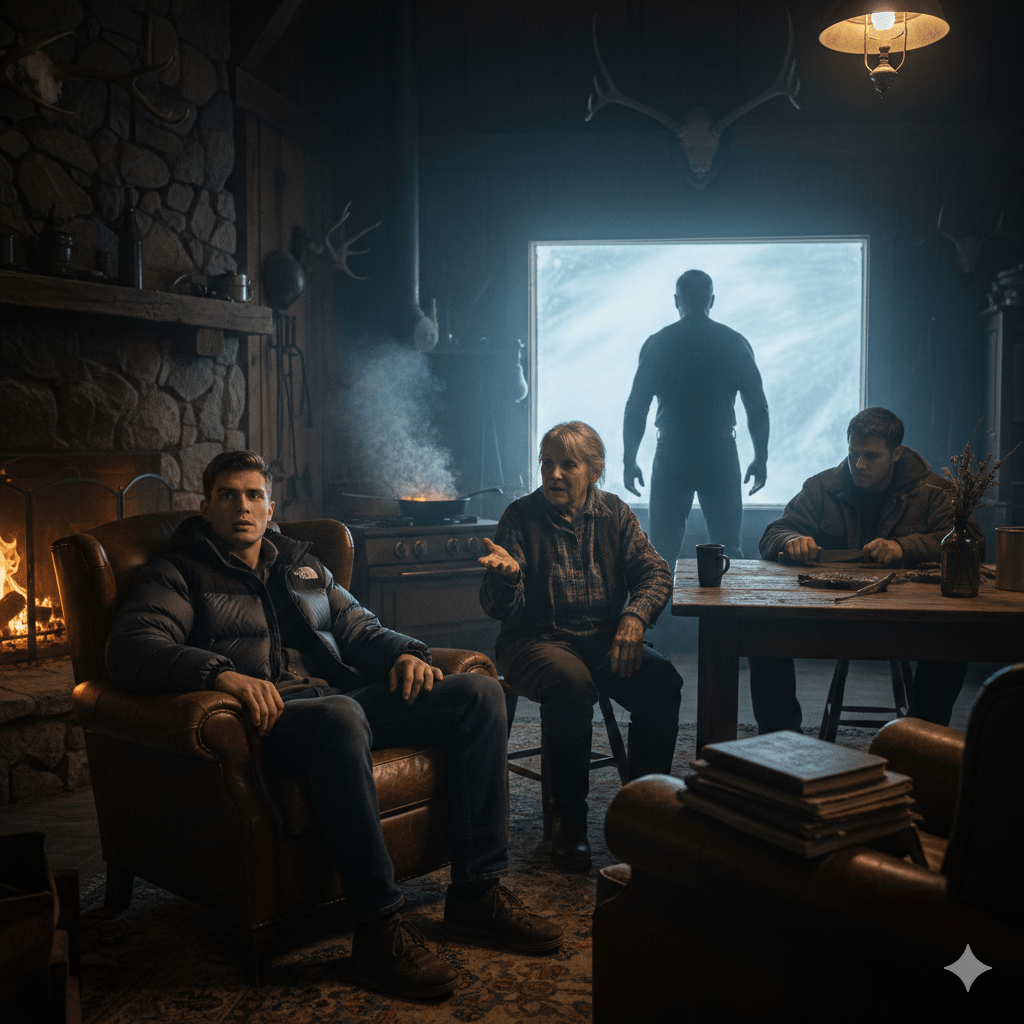
I was stuck in the main den with Heath. The power was flickering, and the only light came from the fireplace, casting huge, flickering shadows that made the deer heads on the wall look like they were watching us.
Heath was sitting in his leather chair, staring into the flames. He hadn’t spoken for an hour. I was clutching my phone, praying for a single bar of LTE so I could at least text my mom that I wasn’t dead.
“Mr. Heath?” I croaked. “Maybe we should… I don’t know, say a prayer? Or talk? Wir müssen reden?“
Heath didn’t even blink. “The heavens are brass today, Luke. No one’s listening.”
The Flashback: The Last Sunset (2007)
Zill had slipped into the room to check the fire, and as she leaned over the hearth, she whispered just loud enough for me to hear over the wind.
“This is how it felt the night the first Cathy died,” she said. “The air was heavy, like it was made of lead. She’d been sick for weeks—not a physical sickness, but a soul-sickness. She was pregnant with Cat, and she was fading. Edgar Linton was sitting by her bed, reading her poetry, trying to ‘civilize’ her deathbed.”
“And Heath?” I whispered back.
“He didn’t wait for an invite. He broke into the Grange like a thief. He found her in that glass room, looking out at the moors. They didn’t have a ‘sweet goodbye,’ Luke. They fought. They clawed at each other’s hearts. Heath told her he could forgive her for what she’d done to him, but he couldn’t forgive what she’d done to herself by choosing that life.”
The Final Break
“She died that night,” Zill said, her voice shaking. “Just as the sun hit the ridge. Edgar was devastated, but Heath… Heath was transformed. He went out to the garden and stood under a pine tree, banging his head against the trunk until the bark was stained red. He didn’t ask for her soul to rest in peace. He begged her to haunt him. To drive him mad. To never leave him in this abyss alone.”
The Present: The Haunting
Suddenly, a massive gust of wind blew the front door open with a bang. The cold air rushed in, extinguishing half the candles. Heath stood up, his eyes wide and vacant.
“She’s here,” he whispered.
“Mr. Heath, it’s just the wind!” I shouted, my “missionary voice” failing me completely. “It’s just the Windstoß! Please sit down!”
He didn’t listen. He walked toward the open door, stepping out onto the porch into the freezing whiteout without a coat. He stood there, arms outstretched, shouting a name into the void that I couldn’t quite hear over the roar of the storm.
I looked at Zill. She just crossed herself—which I think is a Catholic thing, but it felt appropriate—and went back to the kitchen.
I realize now that the “High Fence” isn’t just about the land. It’s about the wall Heath built between himself and the living. He’s already dead; he’s just waiting for the snow to finish the job.
 Chris Snoke